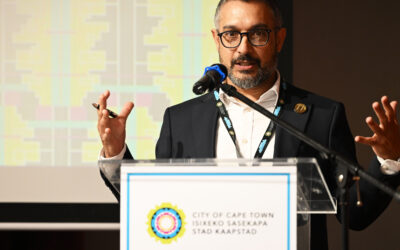
We were honoured to have Alderman JP Smith, Mayoral Committee Member for Safety and Security, join us at our recent thought leadership engagement. Focused on the safety and security of the N2 freeway corridor, one of Cape Town’s most critical economic routes, this session examined both the City’s current interventions and the longer-term implications for business and urban development.
Ryan Ravens, Accelerate Cape Town (ACT) CEO, opened by framing the N2 as both essential infrastructure and a growing risk. As the primary link between the airport and the city, it underpins tourism, logistics, and workforce mobility, yet persistent incidents of violent crime have made it a source of anxiety for residents, investors, and visitors. The cost of inaction, he noted, is seen across business and the economy with rising insurance premiums, logistical detours, investor hesitation, and lost tourism revenue.
He welcomed the City’s decision to act as necessary and overdue. However, he stressed that this must be seen as a starting and not an endpoint. “A wall is a response, not a strategy.” The real question is what follows: will a safer corridor catalyse development in surrounding communities or simply enable people to move past them.
Alderman JP Smith’s presentation provided a detailed account of the City’s operational response and the evolution of its freeway safety strategy. He noted that the need for intervention along the N2 has been recognised for over a decade, with similar challenges now evident on the R300 and increasingly the N7. In response, the City has expanded its deployment significantly, with approximately 140 personnel active daily across key routes.
While acknowledging that policing violent crime on national roads falls outside the City’s formal mandate, JP emphasised that local government has stepped in to address critical gaps.
The revised Freeway Management Operational Plan, implemented in October 2025, integrates intelligence gathering, proactive enforcement, detection-driven response, and co-ordinated communication. Over 50 officers are deployed across two shifts to monitor major freeways and hot spots.
This system is supported by a sophisticated technology backbone that enables real-time tracking of vehicles, rapid dispatch, and on-the-ground reporting through handheld devices. Officers can verify vehicle details, issue fines, and capture evidence instantly. This is complemented by CCTV surveillance, drones, dashcams, and body-worn cameras, as well as data-driven tools such as heat mapping to identify high-risk zones.
Daily operational co-ordination through a central ‘war room’ ensures alignment across agencies, supported by a joint public safety operations centre and dedicated intelligence functions.
The results have been significant. Between July 2025 and January 2026, over 8,500 calls for assistance were logged across major highways, with just over 1% relating to crime. During this period, 148 arrests were made, and serious incidents on the N2 dropped from an average of eight per week to approximately two per month. Response times have improved markedly, with 80% of incidents attended to within five minutes. Tactical shifts, including the use of unmarked vehicles and more proactive freeway monitoring, have further strengthened enforcement.
The N2 safety barrier project forms a key component of the City’s broader intervention, but it is not a standalone solution. Initiated at the request of the Mayor, the project is driven by safety concerns related to crime, pedestrian movement, and roaming livestock along the corridor. Originally led by the Spatial Planning and Environment Department, with the project charter signed in February 2025, it is now in the process of being handed over to Urban Mobility for implementation.
Beyond barrier repairs and reinforcements, the project, positioned as part of the broader ‘N2 Edge’ initiative, aims to deliver tangible safety improvements for both motorists and adjacent communities.
These include new pedestrian crossings, improved lighting and access control, safety measures for recreational spaces, safer grazing practices, and reduced opportunities for illegal dumping. Importantly, the project is expected to reduce pedestrian fatalities while improving overall corridor functionality.
From a planning and funding perspective, the project is progressing through several phases. A capital budget of R107 million has been allocated for detailed design and construction, alongside operational expenditure to support planning processes. While some funding gaps remain, particularly in future years, these are expected to be addressed through adjustment budgets.
Timelines have been accelerated to enable delivery. Scoping is scheduled for completion in mid-2026, followed by feasibility and conceptual design by the end of the year. Detailed design is expected to conclude by mid-2027, with construction commencing shortly thereafter and running over a 24-month period into 2029.
JP emphasised that the barrier must be understood within a wider system that combines human resources, technology, and co-ordinated enforcement. It is one layer in a multi-faceted approach to stabilise and secure the freeway environment.
The session concluded with a robust Q&A, focusing on enforcement capacity, technology, criminal justice constraints, and the economic potential of the N2 corridor.
In closing, Ryan reiterated the need for stronger business participation. He noted that despite the significant economic implications of the N2, the private sector has largely remained absent from the conversation. He called for greater advocacy and collective action, emphasising that securing the corridor is not only a public safety imperative, but a critical step toward unlocking inclusive economic growth.
ACT remains committed to fostering cross-sector collaboration to address complex urban challenges and unlock shared economic value.
We thank our guests and members for their continued support, and BDO for partnering with us as event sponsor.