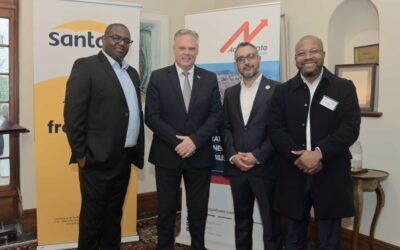
We were honoured to welcome Mayor Geordin Hill-Lewis to the latest in our series of events connecting local government and Western Cape businesses. During the event, Mayor Hill-Lewis offered an optimistic overview of the City’s ongoing progress – highlighting the impact of infrastructure investment, job creation, improved service delivery, and a strong commitment to economic resilience.
Ryan Ravens, CEO of Accelerate Cape Town (ACT), opened the discussions by describing Cape Town’s status as a beacon of hope and opportunity. As South Africa’s best-performing metro and the only municipality with a clean audit, it demonstrates the impact of responsible leadership and strong partnerships. However, with rapid population growth comes challenges and Ryan stressed the need for greater and continuing collaboration between government, business, and academia – especially in the use of technology and AI to tackle pressing issues.
Reflecting on the past year, Mayor Hill-Lewis referenced recent performance data highlighting Cape Town’s job creation and reduced service failures as key indicators of success. He also highlighted the City’s long-term residential property price growth, which has steadily outperformed other cities for several years.
With reference to the City’s capital investment – whilst Cape Town has maintained annual capital investment over two decades, population growth has outpaced infrastructure expansion. This has put strain on basic services like roads, water, electricity, and sanitation.
Funding this expansion is a challenge, and the City has three main revenue sources. Firstly, national government funding makes up only a small percentage of the budget. Mayor Hill-Lewis noted that the City is actively advocating for increased national funding and has welcomed several reforms in the latest budget, including a greater commitment to infrastructure investment. Secondly, the City is taking on more loans. Cape Town is in the enviable position of having almost no debt: its debt-to-income ratio is under 10%, and only 1.6% of its income goes toward servicing debt. Additionally, recent upgrades by rating agencies mean Cape Town can now attract more favourable financing rates from around the world.
Thirdly, the City relies on income from its ratepayers. While this has sparked debate and controversy, Mayor Hill-Lewis believes it has also created an opportunity to explain why these investments are essential and must be funded. This is not a luxury; it is a choice between success and failure.
Beyond infrastructure, the Mayor highlighted efforts to improve the ease of doing business. In the absence of suitable global benchmarks, Cape Town developed its own local ‘Ease of Doing Business Index’—a survey-based tool that tracks and publicly reports progress in key areas, such as reducing red tape. These initiatives have attracted international attention, including from the World Bank.
The demand and supply of housing remains a critical priority. Legislative reforms are being introduced to streamline planning and speed up delivery. A critical area being addressed is that of cost-effective rental options, especially for those priced out of the formal housing market despite earning a monthly income.
Aligned with the enormous strain on the City’s network, water and sanitation receive the lion’s share of investment. Mayor Hill-Lewis highlighted that the City is currently managing the country’s largest sewer upgrade project, valued at R750 million. However, smaller initiatives—such as township stormwater systems—are equally important, as they have a transformative impact on the quality of life in local communities.
The next key focus is safety. While crime prevention is largely a national mandate, the City is investing R6.5 billion into expanding local law enforcement. This includes deploying 700 new officers, with 500 deployed across all wards and 200 protecting frontline staff and infrastructure projects.
Mayor Hill-Lewis also acknowledged progress in areas beyond the City’s direct control. The Department of Home Affairs has responded to calls for visa reform, including improvements to Chinese and Indian visa processes and a simplified system for tourists worldwide to obtain South African visas. Soon, Home Affairs will launch an electronic travel authorisation system enabling visitors from anywhere in the world to receive their visa within minutes, conveniently delivered to their mobile phones.
Further, proposed new police regulations could give Cape Town expanded policing powers, allowing for deeper crime-fighting capabilities. Public transport remains a pressing issue, particularly in under-served high-density areas such as the Cape Flats. To help solve this, the City is currently investing in the largest bus expansion project in the country to Khayelitsha and Mitchells Plain (R10 billion).
Mayor Hill-Lewis closed by emphasising that Cape Town’s recent progress is the result of deliberate choices and disciplined investment. We need to build a city that works. And, when it works, people come, and businesses invest, and the cycle of success continues.
The afternoon’s discussions ended with the opportunity for those present to pose questions and discuss issues in greater depth.
Thank you to Santam, our event sponsor, and to all our members for your continued support. Accelerate Cape Town remains committed to strengthening collaboration between local government and the business community, united in our shared mission to drive sustainable economic growth and prosperity for both the region and South Africa.