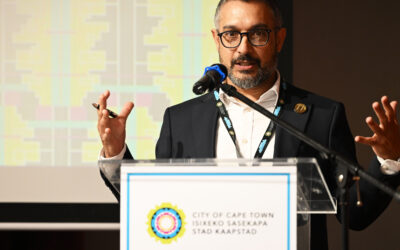
This month, we were honoured to host Dr Raven Naidoo, Executive Chairman of Radian, for an informative and thought-provoking discussion on AI. Opening the discussion, Ryan Ravens, CEO, Accelerate Cape Town (ACT) underlined that artificial intelligence is no longer theoretical but rather is actively disrupting and reshaping business, industries and societies.
He cautioned that businesses in the Western Cape are not ready for the scale of disruption ahead. Further, while AI promises efficiency and growth, it also raises difficult questions for South Africa such as how to balance profit with social justice, employment, and inclusion. Ryan stressed that AI is advancing too quickly to ignore and that leaders must start experimenting, learn by doing, and actively shape policy and governance frameworks rather than waiting for government alone. To this end, Ryan announced Accelerate Cape Town’s forthcoming AI Academy, designed to equip youth with practical skills to apply AI to local challenges.
Dr Raven Naidoo offered a wide-ranging and thought-provoking view of AI’s opportunities and risks. He began by reframing how we think about intelligence itself. The word ‘artificial’ suggests imitation, but AI is not about replicating human intelligence. It is creating something different and immensely powerful.
Dr Naidoo explained that AI’s current rise stems from three converging factors: vast amounts of data, cloud-based storage and huge leaps in processing power. However, at the same time, public understanding is clouded by contradictions. One day AI is hailed as transformative; the next it is portrayed as a threat. Some examples include:
- Education: Students increasingly rely on AI tools such as ChatGPT, reshaping learning methods and creating dependency. Institutions will need to rethink how they teach and assess knowledge.
- Recruitment: CVs generated with AI now flood HR departments, often polished but misleading. Employers must find new ways to validate candidates’ skills, sometimes reverting to pen-and-paper tests.
- Digital economy: AI-driven search is disrupting online business models. When answers are summarised by AI, traffic to underlying websites drops. This is threatening revenue streams based on visibility and SEO.
Dr Naidoo also discussed the global AI ecosystem that encompasses algorithms, foundation model providers (OpenAI, Microsoft, Google), cloud platforms, data management systems, and chip manufacturers such as Nvidia. The global race is dominated by the US, China, and Europe, with China pushing aggressively to secure patents and intellectual property. This could see every AI system eventually paying royalties to a Chinese patent holder.
He also shared that the sheer energy demands of AI are reshaping the technology landscape. Companies like Google and Meta are now potentially investing in nuclear power to fuel their data heavy models and requirements. This signals both the scale of opportunity and the unintended consequences of rapid AI adoption.
The risks, Dr Naidoo emphasised, are not abstract. He cited a case where a finance team attended a virtual meeting in which all but one of the participants (including the CFO) were AI-generated. The only human was instructed to transfer funds, exposing how convincingly AI can be used for fraud.
In South Africa, Dr Naidoo warned, AI adoption is often unmanaged. Many firms use AI informally without governance, exposing themselves to risks when sensitive data is entered into open systems. He cautioned that whilst we may not see the dangers just yet, it will become evident in time.
Referencing the labour market, Dr Naidoo shared that while manual labour roles may persist for now, professional and graduate-level positions are increasingly vulnerable. He stressed that AI is coming first for knowledge workers.
Dr Naidoo stressed that AI is already good enough and that waiting for better or cheaper models is dangerous. He cautioned that the longer the wait, the further behind we will fall. It is not going away. This requires action – manage internal risk, develop a competitive strategy, seek out opportunities and rethink one’s business. Regarding implementation of AI in business, Dr Naidoo outlined a few key steps:
- Define business objectives
- Assess AI readiness
- Start with pilot projects
- Scale successful pilots across business units
- Build governance and compliance framework
- Build long term investments in AI talent, tools and training
- Elicit feedback for continuous improvement to AI models
- Foster a data driven culture
This was followed by a presentation by Cerebral Circuit, who shared real life examples of AI in local business.
- Retail: A WhatsApp-based virtual stylist called Stella who offers stylist and fashion suggestions linked to an e-commerce catalogue.
- Wine: An AI sommelier accessible via WhatsApp, trained on industry handbooks, broadening consumer engagement beyond traditional wine markets.
- Accessibility: A mobile tool using cameras and AI to audit building or venue access (e.g. wheelchairs), that has halved assessment time.
- Education: An AI tutor supporting distance learners, providing exercises, examples, and general student support. An unexpected benefit is a weekly email from the AI tutor to the educator summarising weekly queries, most frequently asked questions, potential skill gaps, etc. This has both improved student support and is helping to refine the current curriculum.
Each example showed how focused AI applications can deliver measurable growth, productivity and innovation across very different sectors.
The morning’s presentations ended with a dynamic Q&A session during which members could discuss in greater detail AI issues specific to their own business or sector.
Ryan closed by reminding attendees that AI is advancing faster than many organisations realise and that it is already outperforming some of the brightest human minds. He stressed that the question is not whether AI will reshape business and society, but rather how we will respond. The time for proactive experimentation and learning is now.
Accelerate Cape Town is dedicated to fostering constructive dialogue across business, government and civil society, using this platform to strengthen collaboration where it matters most. Our priority is to turn conversations into measurable impact, driving initiatives that advance economic growth while supporting long-term resilience and sustainability.
Thank you to our guest speakers and members for your continued support and to our event sponsor, Forvis Mazars.