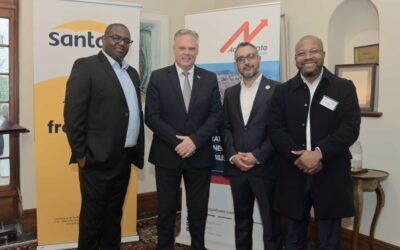
CEO Engagement with Mayor Hill-Lewis
The Mayor Hill-Lewis engagement formed part of Accelerate Cape Town’s ongoing series of events connecting local government with Western Cape businesses. We were honoured to welcome Mayor Geordin Hill-Lewis, who shared an optimistic overview of Cape Town’s progress and outlined the City’s priorities for infrastructure, job creation, service delivery and economic resilience.
Cape Town’s Progress and Economic Opportunity
Ryan Ravens, CEO of Accelerate Cape Town (ACT), opened the discussion by describing Cape Town as a beacon of hope and opportunity.
As South Africa’s best-performing metro and the only municipality with a clean audit, Cape Town demonstrates the value of responsible leadership and strong partnerships. However, rapid population growth continues to place pressure on the City.
Ryan stressed the need for greater collaboration between government, business and academia, particularly in using technology and artificial intelligence to address pressing urban challenges.
Reflecting on the past year, Mayor Hill-Lewis referenced recent performance data showing strong job creation and fewer service failures as key indicators of progress. He also highlighted Cape Town’s long-term residential property price growth, which has consistently outperformed other South African cities.
Infrastructure Investment and Population Growth
Infrastructure investment was a major focus of the Mayor Hill-Lewis engagement.
Although Cape Town has maintained annual capital investment for more than two decades, population growth has outpaced infrastructure expansion. This has increased pressure on essential services, including roads, water, electricity and sanitation.
Funding this expansion remains a significant challenge. The City relies on three primary revenue sources.
The first is national government funding, which contributes only a small percentage of Cape Town’s overall budget. Mayor Hill-Lewis explained that the City continues to advocate for increased national support and has welcomed reforms in the latest budget, including a stronger commitment to infrastructure investment.
The second source is borrowing. Cape Town is in the favourable position of having relatively low debt, with a debt-to-income ratio below 10%. Only 1.6% of the City’s income is currently used to service debt.
Recent upgrades by rating agencies also mean Cape Town can access more favourable financing rates from lenders around the world.
The third source is revenue from ratepayers. Although this has generated debate and controversy, Mayor Hill-Lewis argued that it has also created an opportunity to explain why infrastructure investment is essential.
These investments are not a luxury. They represent a choice between long-term success and failure.
Improving the Ease of Doing Business
Beyond infrastructure, the Mayor highlighted the City’s work to improve the ease of doing business in Cape Town.
In the absence of suitable global benchmarks, the City developed its own local Ease of Doing Business Index. This survey-based tool tracks and publicly reports progress in important areas, including the reduction of red tape.
These initiatives have attracted international attention, including interest from the World Bank.
For Cape Town businesses, reducing administrative barriers and improving municipal processes remain important parts of building a more competitive and resilient economy.
Housing and Affordable Rental Options
Housing demand and supply remain critical priorities for the City.
Legislative reforms are being introduced to streamline planning processes and accelerate housing delivery. A key area of focus is the provision of cost-effective rental options for people who earn a monthly income but remain priced out of the formal housing market.
Addressing this gap is essential as Cape Town’s population continues to grow.
Water and Sanitation Investment
Water and sanitation receive the largest share of the City’s infrastructure investment because of the significant strain on these networks.
Mayor Hill-Lewis highlighted that Cape Town is currently managing the country’s largest sewer upgrade project, valued at R750 million.
However, he noted that smaller initiatives are equally important. Projects such as township stormwater systems can have a transformative effect on the quality of life in local communities.
Expanding Safety and Law Enforcement
Safety was another major topic during the engagement.
Although crime prevention is primarily a national government responsibility, the City is investing R6.5 billion in expanding local law enforcement.
This includes the deployment of 700 new officers. Of these, 500 will be deployed across all wards, while 200 will protect frontline staff and major infrastructure projects.
Mayor Hill-Lewis also referred to proposed police regulations that could give Cape Town expanded policing powers and strengthen the City’s ability to combat crime.
Visa Reform and Tourism Growth
Mayor Hill-Lewis acknowledged progress in areas that fall outside the City’s direct control.
The Department of Home Affairs has responded to calls for visa reform, including improvements to visa processes for Chinese and Indian travellers and the introduction of a simpler system for international tourists.
Home Affairs is also expected to launch an electronic travel authorisation system that will allow visitors to receive visa approval digitally and more efficiently.
These reforms could support tourism, investment and economic growth in Cape Town and the broader Western Cape.
Public Transport and the Cape Flats
Public transport remains a major challenge, particularly in high-density and under-served areas such as the Cape Flats.
To address this, the City is investing R10 billion in what Mayor Hill-Lewis described as the largest bus expansion project in the country.
The project will expand public transport services to Khayelitsha and Mitchells Plain, helping improve access to employment, education and economic opportunities.
Building a City That Works
Mayor Hill-Lewis closed the discussion by emphasising that Cape Town’s recent progress is the result of deliberate choices, disciplined investment and long-term planning.
The goal is to build a city that works.
When a city works, people are attracted to it, businesses invest and the cycle of success continues.
The afternoon concluded with an opportunity for attendees to ask questions and discuss the issues in greater depth.
We thank Santam, our event sponsor, and all Accelerate Cape Town members for their continued support.
Accelerate Cape Town remains committed to strengthening collaboration between local government and the business community. Through these partnerships, we aim to support sustainable economic growth and long-term prosperity for Cape Town, the Western Cape and South Africa.